

A company may be paying more corporate income tax than necessary and, even so, miss out on a deduction for funding cultural activities simply because it didn’t do the math beforehand.
Tax incentives for culture are a very attractive tool when used appropriately, a delicate matter when applied without prior calculation, and especially sensitive if presented solely based on the 120% figure.
In 30 seconds: Tax Incentives for Businesses in the Cultural Sector
- Cultural tax incentives are deductions provided for under the Corporate Income Tax Law for certain certified cultural projects.
- Article 36 of the LIS specifies which projects qualify for a tax deduction, such as audiovisual productions and certain live performances.
- Article 39.7 of the Corporate Income Tax Law (LIS) allows a financing company to claim tax deductions arising from such projects, provided it meets the legal requirements.
- The 120% limit does not guarantee a return on investment: it depends on the contribution amount, the available quota, the deduction limits, and the documentation for the transaction.
- The incentive is a tax deduction, not a grant or an investment based on the commercial success of the production or performance.
- Project certification, the absence of conflicts, and the correct legal structure are essential for applying the deduction with confidence.
The decision-making process, in a nutshell
First, your tax capacity (expected tax liability, limits, and deductions already committed); next, the project (certification and absence of affiliation); and only at the end, the amount and structure (how much to contribute and whether a contract or an AIE is more appropriate).
This article follows that order and explains it step by step in the method described at the end.
The regulation may allow a financing company to participate in certified cultural projects and claim certain deductions on its corporate income tax.
But a thorough analysis doesn’t start with the percentage. It starts elsewhere: available funding, deduction limits, project certification, the contract, and documentation that can be defended before the AEAT.
That’s why, before financing an audiovisual production, a live performance, or a cultural project, the useful question isn’t “how much can I deduct?” but rather, “Can my company safely apply this incentive and truly take advantage of it this fiscal year?”
What Are Tax Incentives for Culture, and How Do They Work for Businesses?
The basic premise is simple: a company can fund a certified cultural project and, under certain conditions, claim a deduction on its corporate income tax.

Cultural tax incentives are deductions provided for in the Corporate Income Tax Act for certain certified audiovisual projects and live performances, which may be claimed by the producer or a financing company when the conditions set forth in the regulations are met.
A cultural financing transaction typically involves two parties.
- The first is the producer or promoter of the cultural project, who carries out the audiovisual production, live performance, or activity that gives rise to the right to a deduction.
- The second is that of the financing company, which provides funds for the project and may claim the deduction on its own corporate income tax return if the transaction is structured correctly in accordance with Article 39.7 of the Corporate Income Tax Law.
An important point: the tax refund does not depend on the commercial success of the film, series, festival, or show, although it does depend on the project’s compliance with tax, documentation, and certification requirements.
Difference Between a Tax Incentive, a Grant, and a Traditional Investment
This is where the first point of confusion usually arises: analyzing tax incentives for culture as if they were a subsidy or an ordinary cultural investment.
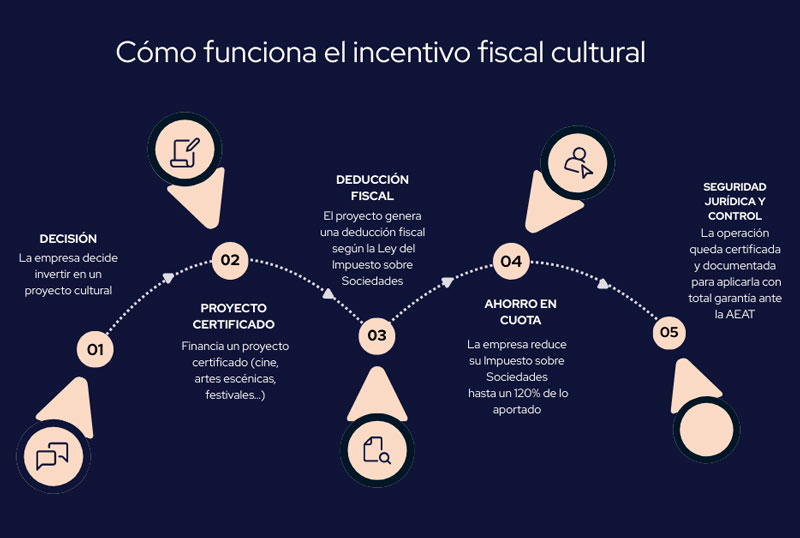
A cultural tax incentive is not a subsidy. The company does not apply for public aid nor does it await a decision granting the aid in order to receive funds. However, it should not be understood as an investment based on the commercial exploitation of the work either.
The rationale is purely fiscal: the company helps finance a certified cultural project, and if it meets the legal requirements, it can claim a deduction against its corporate income tax liability.
The value of tax incentives in the cultural sector depends on the company’s actual eligibility, the project’s certification, and the legal traceability of the transaction.
This difference is important in order to avoid making excessive promises.
The law allows for tax deductions under specific conditions; however, it does not turn every cultural contribution into an automatic tax savings.
Would you like to find out if your company can take advantage of this incentive before the end of the fiscal year?
If your company pays corporate income tax and is considering funding a cultural project, please contact us.
What roles do the producer and the financing company play?
The cultural producer carries out the project and generates a potential right to a tax deduction if the project meets the requirements of Article 36 of the Corporate Income Tax Law (LIS).
The financing company provides funds for the project and may claim the deduction on its own corporate income tax return if the transaction meets the conditions set forth in Article 39.7 of the Corporate Income Tax Law.
That distinction must be clear from the start.
The producer is not merely a recipient of funds, and the financing company does not act as a generic sponsor.

In practice, the financing company should review three issues before committing to the contribution:
- if the cultural project qualifies for a tax deduction;
- if the company has sufficient quota and available limits to apply the incentive;
- if the contractual and documentary framework allows the deduction to be defended before the tax authorities.
Regulatory Framework for Tax Incentives in the Cultural Sector
When discussing tax incentives for culture, one figure stands out: the 120% deduction. However, the validity of the transaction will always depend on how Article 36 of the Corporate Income Tax Law (LIS), Article 39.7 of the LIS, cultural certification, and the deduction limits all fit together.
The two articles that support the operation
- Article 36 of the LIS — Which Projects Qualify for a Tax Deduction: This article identifies cultural projects that may qualify for a tax deduction, generally linked to certain audiovisual productions and certain live performing arts and musical performances. Not every cultural project automatically qualifies for a tax deduction by a funding company: the project must meet the legal criteria, satisfy the technical requirements, and provide the documentation necessary to prove the right to the deduction.
- Article 39.7 of the Corporate Income Tax Law (LIS) — how the financing company applies it: It allows a financing company to participate in the financing of a cultural project and to claim, against its own corporate income tax liability, the deduction generated by that project, subject to the limits and requirements set forth in the law.
Before we continue, it is important to clarify one point regarding this second precept, because it is the one that is most often misunderstood.
Article 39.7 of the Corporate Income Tax Law (LIS) may allow a financing company to claim deductions arising from certified cultural projects, up to a limit of 120% of the amounts contributed, provided it has sufficient tax liability, available limits, and appropriate documentation.
Any reference to 120% should always be made with caution.
Let’s put it simply: the deduction applied by the lender cannot exceed 120% of the amounts contributed, but that figure does not equate to an automatic return.
Contribution to the projectUpper limit set at 120%Critical condition100.000 €Deduction cap of up to 120,000 €. This is not a refund or a return: it is the maximum deduction limit on the tax liability, which can only be reached if there is sufficient tax liability and available limits.Only if there are sufficient funds, available credit limits, a certified project, and appropriate documentation.
There is also one filter you should check before any other: the link.
The AEAT states that the provisions of Article 39.7 of the Corporate Income Tax Law (LIS) do not apply when the taxpayer participating in the financing is related, within the meaning of Article 18 of the LIS, to the taxpayer who gives rise to the right to the deduction.
Simply put: if the financier and the producer belong to the same group or are under common control, the incentive may be completely ruled out.
And the process doesn’t end with applying the deduction; you also have to report it correctly.
The AEAT requires specific information to be included on Form 200 for taxpayers who contribute to the financing of Spanish film productions or live performing arts and musical performances; thus, the contribution must be reported where required by law, not merely calculated.
ICAA and INAEM: Why Certification Is Essential
Cultural certification is a central component of the operation’s document security.
In the audiovisual sector, the ICAA may be involved in certifying the cultural nature of films and audiovisual series—whether fiction, animation, or documentary—that need to demonstrate this status in order to qualify for tax deductions.

For live performing arts and musical performances, the INAEM has a specific procedure for issuing the certificate required for the tax deduction under Article 36.3 of the Income Tax Law (LIS).
For this reason, certification should not be treated as a minor administrative formality. It is one of the main pieces of evidence used to demonstrate that the transaction is based on a cultural project eligible for a tax deduction.
Which companies can benefit from tax incentives for culture?
Before evaluating a cultural project, the company must confirm whether it can claim the tax deduction for that specific fiscal year.
Company StatusProbable lineupThings to Consider Before Making a DecisionA profitable company with sufficient equity and available credit limitsIt may be eligible if the cultural project is certified and the transaction is properly documented.Installment simulation, limit review, financing agreement, certification, and implementation schedule.A profitable company, but one that has already committed to R&D&I tax credits or other incentivesIt may be partially applicable, but the cultural incentive competes for tax capacity with other deductions.Overview of deductions for the fiscal year, order of application, available limits, and risk of non-utilization.Company with low revenue, losses, or uncertainty regarding the fiscal year-endThe fit is weak or should be analyzed with particular caution.Updated tax forecast, year-end scenarios, and whether it is advisable to postpone or adjust the financing amount.Business group or company with operations linked to the producerThere may be a significant risk if there is an affiliation as defined in Article 18 of the LIS.Analysis of the relationship, transaction structure, and compliance with the provisions of Article 39.7 of the Corporate Income Tax Law (LIS).
When does this apply to a company subject to corporate income tax?
Incentives generally make more sense for companies that are profitable, have sufficient market share, and are able to plan ahead before the end of the fiscal year.
It may be a good fit if the company meets these conditions:
- It is subject to corporate income tax.
- It projects sufficient profit and revenue for the fiscal year.
- It has room within the applicable deduction limits.
- It does not use up its entire deduction allowance with other incentives, such as R&D&I or other deductions.
- Look for a tax planning tool with a verifiable legal structure and documentation.
- You can review the transaction before the fiscal year-end and coordinate it with your fiscal year planning.
It may also be of interest to groups that review their tax deduction strategy annually and are looking for alternatives to R&D&I, investments, or other tax incentives.
The Natural Profile is a company that seeks to optimize its corporate income tax without resorting to speculative structures.
Would you like to find out if your company can take advantage of this incentive before the end of the fiscal year?
If your company pays corporate income tax and is considering funding a cultural project, please contact us.
When it doesn’t apply: losses, low credit limit, or maxed-out limits
The tax incentive for culture may not be appropriate if the company is operating at a loss, if it expects to have a very low tax liability, or if it has already reached its deduction limits through other incentives.
It may also not be the right fit if the company is seeking immediate liquidity. We have already explained that this mechanism can reduce the tax liability if the requirements are met, but it should not be presented as a cash flow financing solution.
Situations Where It Is Best to Exercise Caution
- Company without sufficient quota: The deduction may not be properly applied in the intended fiscal year.
- Limits subject to other deductions: The cultural incentive must be coordinated with R&D&I, investments, and other tax benefits.
- Lack of documentation: Without a contract, certification, and traceability, the risk of an audit increases.
- Transactions involving affiliated parties: The relationship between the financier and the producer must be reviewed before applying the regime.
What happens if you already claim R&D&I or other tax deductions?
A company that already claims deductions for R&D&I, investments, or other incentives should analyze how they all fit together.
The cultural incentive competes for quota limits with other deductions and may require coordinated planning to prevent part of the incentive from going unused or being applied at a tax-inefficient time.
In a well-organized planning process, the analysis should address the following questions:
- What is the projected quota for the fiscal year?;
- which deductions have already been allocated;
- what application limits are available;
- What is the schedule for the cultural project?;
- What documentation will be available prior to the filing;
- What funding amount would make sense without exceeding the limits?
This analysis of tax rates, committed deductions, limits, timelines, and documentation is where tax planning adds value. The incentive may be attractive, but only if it is properly integrated into the company’s tax strategy.
Legal Structures: EIA or Financing Agreement
When we talk about tax incentives in the cultural sector, there are two common ways to structure these types of arrangements: the Economic Interest Grouping and the funding agreement.
The two ways to organize the operation
- EIG (Economic Interest Group) — when it makes sense: a structure historically used to channel cultural investments. It is suitable for larger-scale operations involving experienced investors, recurring structures, or projects where the company takes on greater administrative complexity. Its drawback is precisely that complexity: incorporation, corporate governance, maintenance costs, accounting oversight, and a heavier operational burden. It is not usually the best option for a company approaching this incentive for the first time.
- Financing Agreement — the standard approach for the financier: it is usually more straightforward for companies that do not want to establish a specific entity. It reduces administrative hurdles and makes it easier to integrate the transaction into tax planning, although this simplicity does not eliminate the need for rigor: the agreement must be well-drafted, tied to an eligible project, and coordinated with the certification and application of the deduction.
The following table provides a clearer overview of the differences between an AIE and a financing agreement.
AppearanceOh my GodFinancing AgreementLegal StructureIt requires a specific entity to channel the investment.It is established through a contract, without forming a specific corporation.Administrative ComplexityIncreased corporate, accounting, and operational burden.Less internal friction for the financing company.Typical ProfileCompanies with experience, higher volume, or recurring investments.Companies looking for a more direct and controllable approach.Main RiskCost and administrative complexity.The need for well-coordinated contracts, documentation, and certification.Professional judgmentIt may make sense in more complex operations.It is often the most practical option for many financing companies.
Risks, Limits, and Documentation the Company Should Review
When we talk about tax incentives in the cultural sector, the main risk arises when the deduction is applied without a tax file capable of supporting it—not just a business justification.
RiskWhat the company should reviewDocument the recommended controlProject not eligible for a tax deductionThe project’s compliance with Article 36 of the LIS and applicable cultural requirements.Certification from the ICAA, INAEM, or the appropriate agency.Insufficient quotaEstimated tax liability, deduction limits, and deductions already committed.Pre-closing tax simulation.Limits Exhausted by Other IncentivesEligibility for R&D&I, investment, or other tax deductions.Map of deductions for the fiscal year.Transaction with Related PartiesRelationship between the financing company and the producer.Analysis of related-party relationships pursuant to Article 18 of the Income Tax Law (LIS), since the provisions of Article 39.7 of the LIS do not apply when there is a related-party relationship between the lender and the party giving rise to the deduction.Insufficient documentationContract, contribution, certification, communication, and traceability.Complete tax file for the transaction.Problems with grants or financial aidCompatibility of the funding with public aid received by the project.Review of aid intensity limits and producer documentation.
This table summarizes why the transaction should not be closed without prior analysis. Tax incentives for culture can be useful, but they always require technical oversight.
Minimum Documentation Required Before Claiming the Deduction
- Financing agreement or legal structure used to channel the contribution.
- Proof of contributions and financial traceability of payments made.
- Cultural certification for the project issued by the competent authority, when required.
- Analysis of the tax credit and limits to confirm that the company can claim the deduction for tax purposes.
- Review of the relationship between the financing company and the party generating the right to a deduction.
- Communication documentation and declaration required to properly apply the corporate income tax incentive.
Why Every Document Matters During an Audit
There is one aspect that the previous list does not cover and that should be examined separately: public aid. If the project has received grants or other forms of aid, these may affect the aid intensity limit and the compatibility of the incentive, meaning that the deduction is not always compatible with all the public funding the producer has received.
And when the company already claims other deductions, such as R&D&I, the cultural incentive becomes part of the overall tax planning and competes for the same tax credit limits.
Cultural Sectors That May Qualify for Tax Incentives in the Field of Culture
The cultural tax incentive program does not apply equally to all cultural activities.
The main focus should be on projects specifically covered by tax regulations and on those that can obtain the necessary certification to qualify for a tax deduction.

Movies, TV Shows, and Audiovisual Media
Film productions, TV series, documentaries, and other audiovisual projects are often the best-known and most standardized field.
In these cases, the ICAA typically plays a significant role in cultural certification and the verification of requirements. The maturity of the audiovisual sector facilitates the structuring of operations, although it does not eliminate the need to review the project, costs, schedule, constraints, and documentation.
Music, performing arts, and live shows
Live performances, concerts, festivals, theater, dance, and musical projects may qualify for incentives when they meet the applicable requirements.
In these cases, the INAEM is the relevant agency for certification. The project timeline and expense documentation take on special importance, because live performances may have production, execution, and reporting phases that differ from those of an audiovisual production.
Regional Systems: the Canary Islands, Navarre, and the Basque Country
The location of the project or the taxpayer may introduce additional variables.
The Canary Islands, Navarre, and the Basque Country have their own unique tax characteristics, due to their economic and tax systems or regional regulations; therefore, it is not advisable to automatically extrapolate the analysis of the common system to them.
How Carrillo Handles a Cultural Tax Incentive Program
Carrillo is a pioneer in transactions involving tax incentives for the arts. Since 2018, we have been assisting funding organizations and producers in structuring cultural financing transactions, with more than 1,000 certified projects.
That is why we know that a well-planned operation begins before selecting a project: by reviewing the tax rate, limits, deductions already committed, and the tax calendar.
According to Carrillo, the approach is based on the following premise: a deduction only makes sense if it can be supported by documentation, subject to applicable limits, and in accordance with tax regulations.
- Tax assessment of the company: review of estimated tax liability, deductions already planned, available limits, and closing schedule.
- Analysis of the incentive’s applicability: assessment of whether Article 39.7 of the Corporate Income Tax Law (LIS) could be beneficial to the company in that specific fiscal year.
- Review of the cultural project: verification of the type of project, certification, eligible expenses, and available documentation.
- Choosing the legal structure: analyzing whether a financing agreement, an AIE, or another legally appropriate option is appropriate.
- Preparation and review of documentation: contract, supporting documents, certifications, correspondence, and tax records related to the transaction.
- Tax filing and monitoring: coordination with the corporate income tax return, limits, Form 200, and support in the event of potential audits.
This method avoids treating tax incentives for culture as a one-size-fits-all solution. Every company has a different tax situation, and every cultural project has its own specific requirements.
Do you need to review the transaction before the fiscal year-end?
Before committing to a contribution, it is advisable to verify the available funding, the applicable limits, the cultural certification, and the funding agreement.
Frequently Asked Questions About Tax Incentives for Cultural Initiatives for Businesses
What are cultural tax incentives?
Tax incentives for culture are deductions provided for under the Corporate Income Tax Law for certain certified cultural projects, such as audiovisual productions and live performances. These deductions may be claimed by the producer or, under certain conditions, by a financing company.
What does Article 39.7 of the Corporate Income Tax Law (LIS) stipulate regarding tax incentives for culture?
Article 39.7 of the LIS governs the possibility for a funding company to claim deductions arising from certain cultural projects, provided that it meets the legal requirements, has sufficient taxable income, complies with the applicable limits, and properly documents the transaction.
What is the difference between Article 36 of the LIS and Article 39.7 of the LIS?
Article 36 of the LIS governs which projects are eligible for tax deductions. Article 39.7 of the LIS allows a financing company to claim certain deductions generated by those projects, provided that the conditions set forth in the law are met.
Can a company claim a tax deduction of 120% of its contributions?
The deduction available to the financing company cannot exceed 120% of the amounts contributed, but that figure does not imply an automatic return on investment. The application depends on the available quota, deduction limits, project certification, documentation, and compliance with the requirements of Article 39.7 of the Corporate Income Tax Law (LIS).
Is the cultural tax incentive a grant?
No. The cultural tax incentive is not a grant, nor does it depend on a call for applications. It is a regulated tax deduction that can be applied to corporate income tax when an eligible cultural project is funded and the legal requirements are met.
Which companies are eligible for tax incentives related to culture?
Companies subject to corporate income tax that have sufficient taxable income and margin within the deduction limits may consider this incentive. It generally does not apply to companies with losses, very low taxable income, or limits that have been exhausted by other deductions.
What roles do the ICAA and the INAEM play?
The ICAA is involved in the certification of certain audiovisual and film productions. The INAEM is involved in the certification of certain live performing arts and musical performances. Certification is important because it attests to the cultural nature of the project and strengthens the documentary evidence supporting the tax deduction.
When it comes to tax incentives for cultural projects, is an AIE or a financing agreement better?
It depends on the company’s profile, the size of the transaction, its prior experience, and the level of complexity it can handle. A financing agreement is usually more straightforward for many financing companies, while an AIE may make sense for more complex or recurring transactions.
What are the risks of misapplying the cultural tax incentive?
The main risks include applying the deduction without a certified project, without sufficient funds, without proper documentation, after the limits have been exhausted, with unreviewed incompatibilities, or without properly analyzing the relationship between the financing company and the producer.
What documentation must the financing company retain?
The financing company should retain the contract, proof of contributions, cultural certification, project documentation, quota and limit analyses, necessary correspondence, and tax documentation to claim the deduction on corporate income tax.
What happens if the company already claims R&D&I tax deductions?
The company must verify whether it has room within the applicable deduction limits. The cultural incentive must be coordinated with R&D&I and other deductions to ensure that the tax benefit is properly absorbed in the fiscal year.
How is the optimal investment in tax incentives for culture calculated?
The optimal investment is calculated by considering the available tax credit, the deduction limit, deductions already planned, the amount of the contribution, and the company’s tax calendar. The 120% limit sets the maximum deduction based on the amount contributed, but it does not, by itself, determine how much should be invested. The calculation must be performed on a case-by-case basis before the end of the tax year.
What should a company review before signing the financing agreement?
Before signing the financing agreement, the company should review its available quota, the deduction limits, the project certification, the absence of any affiliation with the producer, compatibility with other grants or incentives, and the documentation required to justify the deduction in the event of an audit.
Can tax incentives for cultural projects be applied if there is insufficient tax credit?
If the company does not have sufficient tax liability or has exhausted its deduction limits, the incentive may not be properly utilized in the intended tax year. Therefore, an analysis of tax liability and limits must be conducted before committing to a contribution to the cultural project.
What are the risks if the project does not obtain certification?
If the project does not obtain the necessary cultural certification, the funding company may lack sufficient documentation to claim the deduction. Certification is a key element in proving that the project meets the legal requirements that entitle it to the deduction.
Regulatory References and Relevant Agencies Regarding Tax Incentives for Culture
The implementation of tax incentives for cultural projects requires a review of the corporate income tax regulations and public certification of the funded project.
- Law 27/2014 on Corporate Income Tax. The primary legislation governing tax deductions for investments in audiovisual productions and live performances.
- Article 36 of the Income Tax Law (LIS). This article governs tax deductions related to certain film productions, audiovisual series, and live performing arts and musical performances.
- Article 39.7 of the Income Tax Law (LIS). This provision allows a taxpayer who participates in the financing of certain productions or performances to claim the resulting deduction, within the limits and subject to the requirements established by law.
- Article 18 of the Income Tax Law (LIS). This provision must be reviewed to rule out any affiliated relationships between the taxpayer providing the financing and the party giving rise to the right to the deduction, since the provisions of Article 39.7 of the LIS do not apply when an affiliated relationship exists as defined by the law.
- Corporate Income Tax Form 200. This form must be reviewed to correctly report the share of funding for Spanish film productions or live performing arts and musical performances, when applicable, along with the formal requirements applicable to the incentive.
- ICAA. The relevant agency responsible for certifying the cultural nature of film productions and audiovisual series that seek to qualify for tax deductions.
- INAEM. The agency responsible for issuing the certificate required for the tax deduction for live performing arts and music performances.
- EU Regulation 651/2014. European framework declaring certain categories of aid compatible with the internal market pursuant to Articles 107 and 108 of the Treaty.
This information on tax incentives for culture is of a general nature and does not constitute individualized tax advice. The application of cultural tax incentives must be analyzed on a case-by-case basis, taking into account current regulations, the company’s tax situation, project certification, deduction limits, and the available documentation.