

When a company conducts transactions that are both eligible and ineligible for VAT deduction, it cannot always deduct all of the input VAT.sSSZZZZZZZSXX
The problem usually arises at the end of the fiscal year: a provisional percentage is applied throughout the year, but in the final period, the final prorated amount must be calculated to verify whether the VAT claimed as a deduction matches the amount that was actually due.
In 30 seconds: the key points of this post
- The VAT pro rata rule applies when a company combines transactions that are eligible for a deduction with those that are not.
- A provisional prorated amount is typically used during the year; at year-end, the final prorated amount must be calculated and the difference adjusted.
- If the final prorated amount is lower, the company has deducted too much VAT and can typically record a negative adjustment in account 634, always ensuring that the journal entry reconciles with the VAT return and the accounting policy applied.
- If the final prorated amount is higher, the company under-deducted VAT and can typically record a credit adjustment in account 639, adjusting the offsetting entry based on the VAT settlement and the accounting policy applied.
- Capital assets are subject to their own rules and may require a review of deductions from prior tax years.
- In a review, what matters most is not just the result of the calculation, but being able to explain how that percentage was arrived at and how the adjustment was accounted for.
When it comes to prorating VAT, the risk lies not only in applying the wrong percentage, but also in being unable to explain why that percentage accurately reflects the nature of the business activity.
In this guide, we explain how to adjust the accounting records for the pro rata share of VAT, how to calculate the difference between the provisional and final pro rata amounts, what accounting entry to make, and what mistakes to avoid before closing the fiscal year.
What Is Pro-Rata VAT and When Does It Affect the Closing of the Books?
The pro rata VAT rule applies when a company simultaneously carries out transactions that give rise to the right to deduct input VAT and transactions that do not allow for such a deduction.
In these cases, the company cannot automatically deduct all the VAT on its purchases and expenses.
You must calculate what percentage of that input VAT is related to transactions eligible for a deduction and what portion should be considered non-deductible.
This occurs, for example, in companies that combine activities subject to VAT and those exempt from VAT with other exempt transactions, or in companies that operate business lines that are treated differently for tax purposes.
Depending on the circumstances, the company may apply either the general pro-rata method or the special pro-rata method.
The general pro rata method calculates an overall deduction percentage, while the special pro rata method requires a more detailed distinction between which input taxes are linked to transactions eligible for deduction and which are not.
This difference may be relevant when reviewing the financial statements.

From an accounting perspective, the pro rata adjustment has an impact because a portion of the input VAT cannot be recorded as deductible VAT.
That amount should be treated as an increase in expenses or, if applicable, as an increase in the value of the acquired asset.
Therefore, at the end of the fiscal year, it is necessary to verify whether the pro-rata percentage applied during the year matches the final pro-rata amount. If they do not match, the difference must be adjusted.
Key point: The pro-rata adjustment is not just a mathematical calculation. It must also align with VAT returns, accounting records, and the documentation supporting the percentage applied.
If, before the filing deadline, you’re unsure whether your company must apply this rule, you can review this analysis on when there is an obligation to apply the VAT pro rata rule.
Provisional prorating and final prorating: the origin of the adjustment
The accounting adjustment for the prorated portion of VAT occurs because the final percentage of deductible VAT is not always known during the fiscal year.
In practice, many companies start the year by applying the pro-rata percentage from the previous fiscal year.
That percentage serves as a provisional pro rata allocation.
At the end of the fiscal year, the actual percentage for the current year is calculated based on the transactions carried out.
Comparing these two percentages reveals whether the company has correctly deducted input VAT or whether it needs to adjust the result.
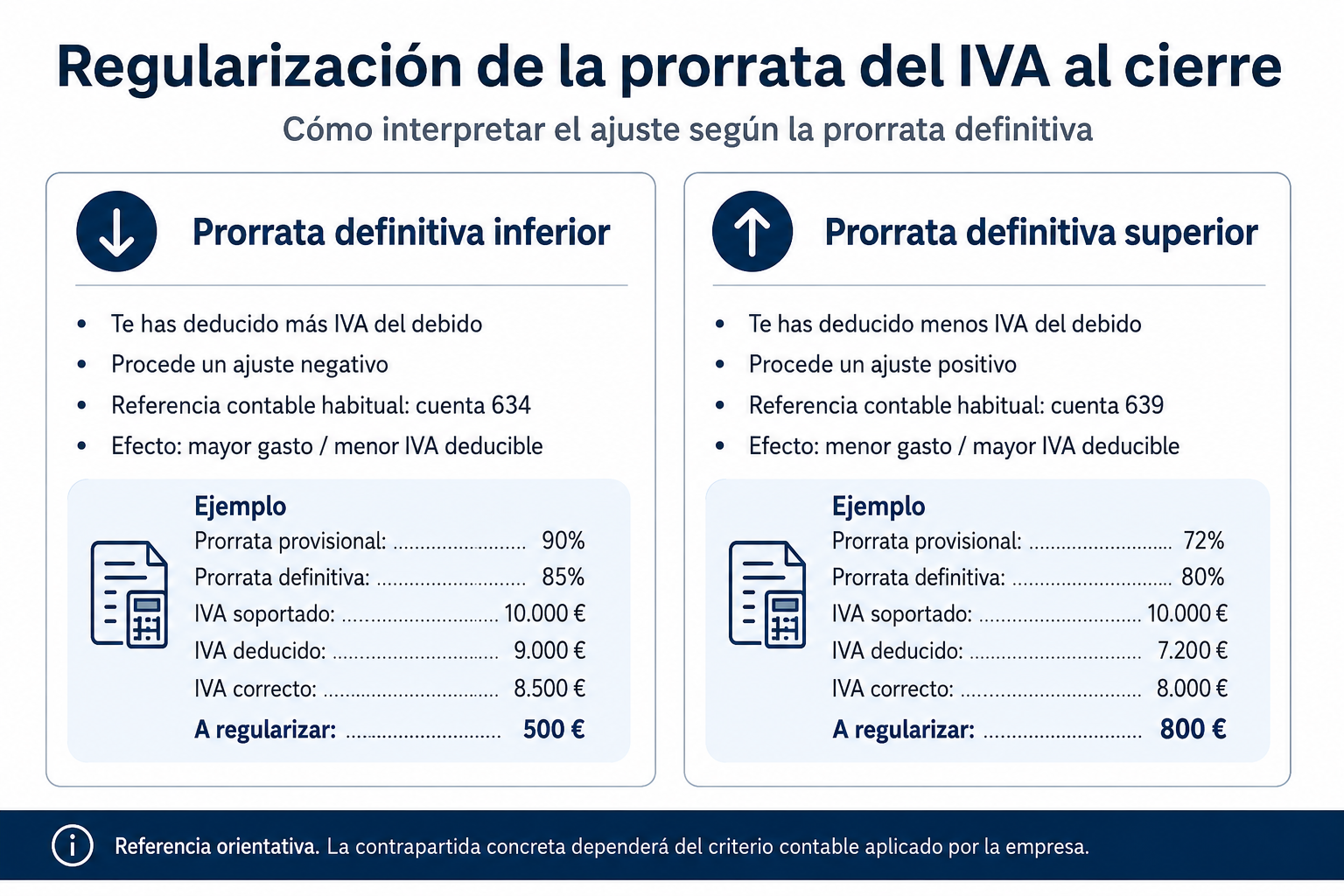
SituationConsequenceStandard accounting treatmentThe final pro rata amount is equal to the provisional amountThere is no significant difference between the amount deducted and the amount that should have been deducted.There is usually no significant adjustment for this item.The final pro rata amount is lower than the provisional oneThe company has deducted more VAT than it should have.Negative adjustment to indirect taxes, typically using account 634, always reviewing the tax assessment and the accounting treatment applied.The final pro-rata amount is higher than the provisional oneThe company claimed a smaller VAT deduction than it was entitled to.Positive adjustment to indirect taxes, typically using account 639, always verifying the offsetting entry and the VAT settlement.
In the latter two cases, an accounting adjustment will be necessary so that the input VAT correctly reflects the final percentage for the fiscal year.
How Is the Pro-Rata VAT Adjustment Calculated?
The adjustment is calculated by comparing the input VAT that the company deducted during the year with the input VAT that it was actually entitled to deduct based on the final pro rata rate.
The practical formula is simple.
Total input VAT × final pro rata percentage = correct deductible input VAT
Important note: This formula serves as a basic framework for installments subject to general pro rata allocation. In cases of special pro rata allocation, differentiated sectors, or capital assets, the calculation must comply with the specific applicable rules.
That result is then compared with the VAT that the company has already deducted by applying the provisional pro rata calculation.
To organize the calculation, it is a good idea to review these elements.
ElementWhat to CheckTotal input VAT for the fiscal yearTotal contributions subject to pro-rata adjustment.Provisional pro rata allocationPercentage applied during the year.Provisionally Deducted VATAmount of input VAT deducted in periodic tax returns.Final pro rata allocationActual percentage calculated at the end of the fiscal year.DifferenceAmount that must be adjusted for accounting purposes.
In companies with simple operations, the adjustment can be relatively straightforward.
However, in companies with mixed activities, distinct business segments, real estate transactions, investment assets, or group structures, it is advisable to review the calculation with particular care.
If the final pro rata amount is lower: negative adjustment and account 634
When the final prorated amount is less than the provisional amount applied during the year, the company has deducted more input VAT than it was entitled to.
In this case, the excess VAT deducted must be corrected. The portion of VAT that ultimately is not deductible is typically recorded as an expense through account 634, “Negative Adjustments to Indirect Taxes,” while always reviewing the VAT return and the accounting treatment applied.
The following example shows a simplified calculation.
Example A: The Final Pro-rata Amount Is Lower
Company X has the following data:
- Provisional pro-rata rate applied during the year: 90%.
- Final pro rata for the fiscal year: 85%.
- Total input VAT for the fiscal year: 10,000 €.
During the year, the company deducted 90% of the input VAT: €10,000 × 90% = €9,000 in deducted VAT.
However, when calculating the final prorated amount, he finds that he was only entitled to deduct 85%: €10,000 × 85% = €8,500 in deductible VAT.
The company has deducted €500 too much: €9,000 − €8,500 = €500 to be adjusted.
From a practical standpoint, the adjustment reflects that a portion of the VAT that was initially treated as deductible must now be considered non-deductible.
The accounting entry must reflect that negative adjustment.
AccountMustNews634 Negative Adjustments to Indirect Taxes500 €
VAT account or settlement, as applicable, based on the accounting method used
500 €
With this adjustment, the excess VAT deducted is corrected, and the expense corresponding to the VAT that ultimately cannot be deducted is recognized.
Accounting note: The offsetting entry may vary depending on how your company has configured the accounting for VAT settlements and the closing of Form 303. Therefore, it is advisable to reconcile the journal entry with the settlement for the most recent period.
The same principle of prudence should be applied when the adjustment goes in the opposite direction.
If the final prorated amount is higher: positive adjustment and account 639
The opposite can also happen: the final prorated amount may be higher than the provisional amount applied during the year.
In this case, the company will have deducted less input VAT than it was actually entitled to deduct.
At year-end, you must correct this situation by recognizing a higher amount of deductible VAT.
This adjustment is typically recorded in account 639, “Positive Adjustments to Indirect Taxes,” with the offsetting entry adjusted based on the VAT assessment and the accounting policy applied.
The following example shows the opposite case from the previous one.
Example B: The final prorated amount increases
Company Y has the following data:
- Provisional pro-rata rate applied during the year: 72%.
- Final pro-rata allocation for the fiscal year: 80%.
- Total input VAT for the fiscal year: 10,000 €.
During the year, the company deducted 72% of the input VAT: €10,000 × 72% = €7,200 in deducted VAT.
But when calculating the final prorated amount, he finds that he was entitled to deduct 80 percent: 10,000 € × 80% = 8,000 € in deductible VAT.
The company claimed €800 less in deductions than it was entitled to: €8,000 − €7,200 = €800 to be adjusted.
The accounting entry must reflect that positive adjustment.
As a general guide, the structure would be as follows.
AccountMustNewsVAT account or settlement, as applicable, based on the accounting method used800 €
639 Positive Adjustments to Indirect Taxes
800 €
This journal entry recognizes the higher deductible VAT and corrects the expense that had initially been recorded in excess.
Once again, the entry must be reviewed along with the final settlement for the last period to avoid discrepancies between the accounting records, Form 303, and the internal pro-rata calculation.
What happens if the company applies prorating for the first time?
When a company begins to apply the pro-rata rule for the first time, it must pay special attention to the treatment of input VAT that is not deductible.
Generally speaking, the non-deductible portion of VAT is not recorded as deductible input VAT.
Depending on the nature of the expense or purchase, there may be two ways to handle it.
- As the largest accounting expense, whether it involves purchases, services, or operating expenses.
- As the higher value of the asset, if it pertains to capital assets or capitalizable assets.
This point is important because the pro-rata calculation affects more than just VAT.

It may also affect the net income, the value of certain assets, and the corporate income tax settlement.
Therefore, if a company is applying pro rata for the first time, it is not advisable to simply perform an aggregate calculation at the end of the year.
It is advisable to review how invoices have been recorded since the beginning of the fiscal year and whether the accounting treatment is consistent with the applicable deduction rate.
Investment Assets: A Tax Adjustment That Should Be Reviewed Separately
The adjustment of the prorated VAT does not always conclude with the fourth-quarter adjustment.
When capital assets are involved, specific rules may apply that require deductions to be reviewed over several fiscal years.
This is particularly relevant in the case of acquisitions of real estate, machinery, facilities, equipment, or significant assets used in activities subject to different deduction rules.
The reason is simple: an investment asset can be used for several years, and the applicable deduction rate may vary from one fiscal year to the next.

If the allocation changes or the pro-rata share varies, it may be necessary to adjust part of the VAT initially deducted.
In these cases, it is not enough to review the input VAT for the current fiscal year. It is also advisable to check whether there are any capital assets acquired in prior fiscal years that are still within the adjustment period.
Technical note: For investment property, the adjustment period depends on the type of asset. For land and buildings, the statutory adjustment period is longer than for other types of investment property; therefore, it is advisable to identify the date of acquisition, the VAT initially deducted, the designated use of the asset, and its actual use.
With that in mind, it is also a good idea to review the most common errors that occur when adjusting the pro-rata allocation.
Common Mistakes When Adjusting the Pro-Rata Share of VAT
Adjusting the pro-rata allocation may seem like a simple adjustment, but in practice, certain errors frequently occur during financial closings.
- Do not recalculate the final pro-rata amount at year-end. Applying the provisional percentage for the entire year without calculating the final amount can result in incorrect deductions. The year-end closing should serve precisely to adjust the percentage to reflect the actual figures for the fiscal year.
- Confusing exempt transactions with non-taxable transactions. Not all of them have the same effect on the calculation. Incorrect classification can alter the deduction percentage and result in significant differences.
- Do not adjust for distinct business segments. In some companies, calculating an overall pro rata allocation is not sufficient. If there are distinct business segments, it may be necessary to apply specific deduction criteria.
- Forgetting about capital assets. One of the most common mistakes is to adjust only the input VAT for the fiscal year and fail to check whether there are any capital assets pending adjustment.
- Posting the adjustment to the wrong accounts. The adjustment must reflect whether it is a negative or positive adjustment to indirect taxes. Using inappropriate accounts makes subsequent accounting and tax reviews more difficult.
- Discrepancies between accounting records and VAT returns. The accounting adjustment must be consistent with the VAT return. If the accounting records, Form 303, and the internal pro-rata calculation do not match, discrepancies may arise that are difficult to justify.
- Do not retain the calculation documentation. The company should retain the details of the calculation, the operations included, the criteria used, and the reconciliation with periodic settlements. During an audit, the problem is usually not the result itself, but rather the ability to explain how it was arrived at.
In companies with mixed operations, real estate activities, financial services, education, private healthcare, holding companies, partially exempt entities, or corporate groups with complex structures, these errors can have a significant tax and accounting impact.
How Carrillo Can Help You Regularize Your Pro-Rata VAT
The accounting adjustment for the prorated portion of VAT should not be treated as a standalone closing entry.
In many companies, this adjustment is linked to broader issues: deductibility of input VAT, distinct sectors, capital assets, exempt transactions, revision of Form 303, and the corporate income tax settlement.

At Carrillo, we help companies and corporate groups review their indirect tax obligations with a practical approach that is coordinated with their accounting.
The goal is not just to calculate a percentage, but to verify that the VAT claimed as a deduction accurately reflects the actual business activity and that the financial statements are properly documented.
We can help you review the key points of the closing.
- Check whether your company is required to apply the pro-rata rule.
- Calculate the provisional and final pro-rata amounts.
- Adjust the deductible input VAT at year-end.
- Analyze the accounting treatment of adjustments.
- Review investment assets subject to regularization.
- Coordinate the VAT closing with corporate income tax.
- Prepare supporting documentation in anticipation of a possible tax audit.
If your company applies pro-rata VAT or has questions about deductible VAT at the end of the period, you should review the calculation before filing the return for the last period.
Well-documented record-keeping reduces the risk of subsequent adjustments and ensures that accounting records, VAT returns, and tax-year-end closings accurately reflect the same reality.
Does your company apply prorated VAT?
A preliminary review makes it possible to identify discrepancies before filing the tax return and to better document the criteria followed by the company.
Frequently Asked Questions About VAT Pro-Rata Adjustments
These are some of the most common questions that arise when a company applies the pro rata method and must adjust its deductible input VAT at the end of the fiscal year.
When is the pro-rata VAT adjusted?
The VAT pro rata is adjusted at the end of the fiscal year, when the final deduction percentage is calculated and compared to the provisional percentage applied during the year.
What happens if the final prorated amount is less than the provisional amount?
If the final prorated amount is lower, the company has deducted more input VAT than it was entitled to. In that case, it must correct the difference and typically recognize a negative adjustment in indirect taxes, always reviewing the journal entry against the VAT return and the accounting treatment applied.
What happens if the final prorated amount is higher?
If the final prorated amount is higher, the company has deducted less VAT than it was entitled to. The adjustment allows the company to recognize a higher amount of deductible VAT and record the corresponding positive adjustment, with the appropriate offsetting entry based on the tax assessment and the accounting method used.
Which accounting accounts are used to adjust the prorated VAT?
Typically, account 634, “Negative Adjustments to Indirect Taxes,” is used when the company must reduce its deductible VAT, and account 639, “Positive Adjustments to Indirect Taxes,” is used when it can recognize a higher deductible VAT. The specific offsetting entry will depend on the accounting policy applied and how VAT settlement is structured within each company.
Is non-deductible VAT on a pro rata basis a deductible expense?
Generally speaking, input VAT that is not deductible may be treated for accounting purposes as an additional expense or as an increase in the value of an asset, depending on the nature of the transaction. Its tax impact must be assessed in accordance with corporate income tax rules and the deductibility of the corresponding expense or depreciation.
Does the pro rata rule apply the same way to capital assets?
No. Capital assets are subject to specific rules for amortization over several fiscal years. Therefore, when a company has acquired real estate, machinery, facilities, or other relevant assets, it is advisable to verify whether they are still within the amortization period and what the initially deducted VAT was.
What is the difference between general pro rata and special pro rata?
General apportionment applies a flat deduction percentage to the input tax amounts affected by the apportionment. Special apportionment requires distinguishing between input tax directly linked to transactions eligible for a deduction, those linked to ineligible transactions, and common input tax. For this reason, special apportionment typically requires a more detailed review of invoices, business activities, and allocation criteria.
Does the pro-rata allocation of VAT affect corporate income tax?
Yes, it can. Non-deductible VAT can result in higher expenses or a higher asset value, which may impact the accounting profit and the corporate income tax base, provided that the applicable tax requirements are met.
Glossary: Key Concepts Regarding Pro-Rata VAT
- VAT pro rata: a rule that limits the deduction of input VAT when a company engages in transactions that give rise to a right of deduction and transactions that do not.
- Provisional prorated amount: the percentage applied during the fiscal year, typically based on the final percentage from the previous year.
- Final pro rata: the actual percentage calculated at the end of the fiscal year based on the transactions carried out during the year.
- General pro rata: a system that calculates an overall deduction percentage applicable to input VAT subject to the pro rata rule.
- Special pro-rata allocation: a system that requires distinguishing between directly deductible installments, non-deductible installments, and common installments subject to a pro-rata percentage.
- Deductible input VAT: the portion of VAT paid on purchases, expenses, or investments that a company can deduct in its tax returns.
- Capital assets: assets that may require a review of the VAT deduction over several fiscal years if their use or the deduction percentage changes.
- Account 634: An account typically used to record negative adjustments to indirect taxes when deductible VAT is reduced.
- Account 639: An account typically used to record positive adjustments to indirect taxes when a higher amount of deductible VAT is recognized.
The following references provide the legal and accounting basis for the main criteria explained in the article.
Regulatory References
Official regulations and relevant administrative guidelines for reviewing the pro rata rule and the accounting adjustment of VAT.
- Law 37/1992 on Value-Added Tax. Pro-rata rule, adjustment of deductions, and capital assets.
- VAT Regulations (Royal Decree 1624/1992). Regulatory provisions regarding deductions and pro rata calculations.
- General Accounting Plan (Royal Decree 1514/2007). Accounts 634 and 639, adjustments for indirect taxes.
- Tax Agency’s Practical Guide to VAT. Explanation of the pro-rata rule and adjustment of capital assets.
This article is for informational purposes only and does not constitute personalized tax or accounting advice. The specific application of the pro-rata rule, the adjustment of input VAT, and their accounting treatment depend on each company, its operations, its sectors of activity, its capital assets, and the regulations in effect at any given time.