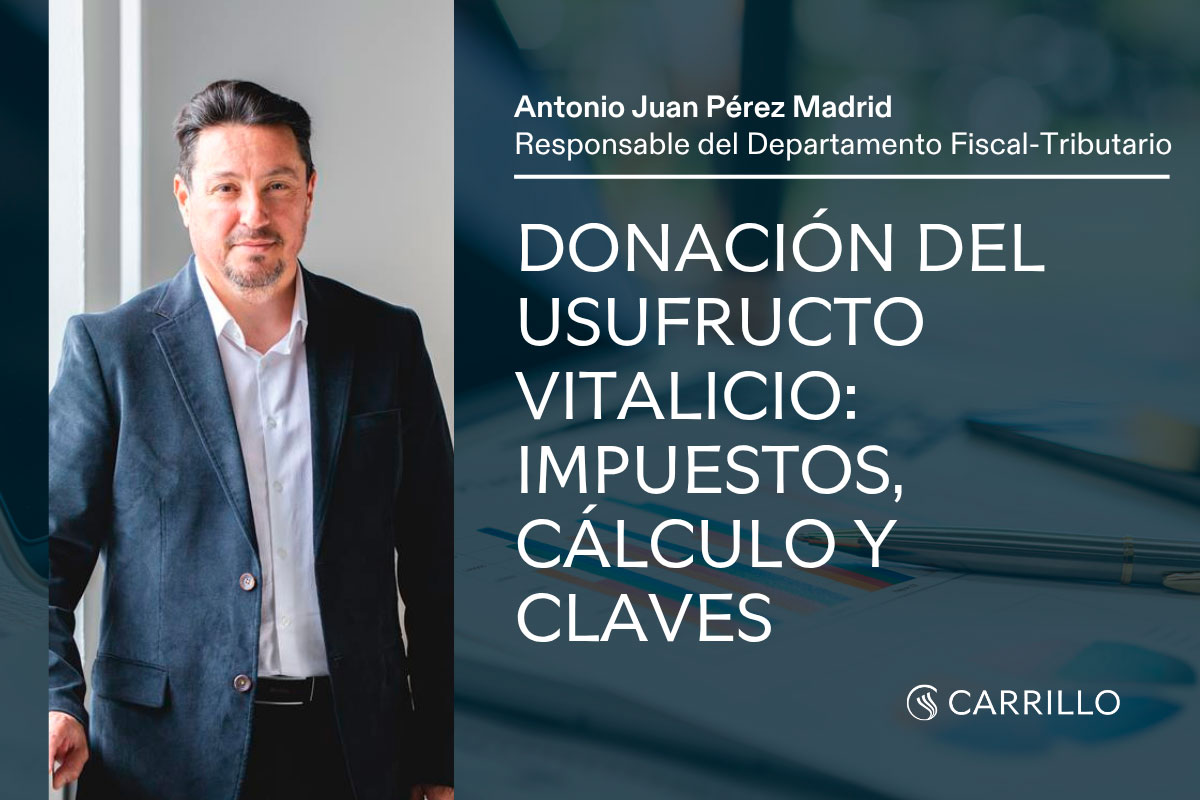
When a property is inherited, it is very common for full ownership not to be transferred directly. Typically, the children receive bare ownership whilst the surviving spouse retains the life interest.
Put simply: one person holds title to the property whilst another retains the right to use or enjoy it for the rest of their life.
So far, this all seems fairly standard. The problem usually arises later.
How is this situation treated for Inheritance and Gift Tax (ISD) purposes?
And what happens if, after some time, the usufructuary decides to transfer that usufruct to the children so that they can consolidate title and become full owners before the usufructuary’s death?
There is no single answer, because several taxes may come into play in this transaction: ISD, personal income tax (IRPF) and municipal capital gains tax.
In 30 seconds: the key points of this post
- The donation of a life-long usufruct can trigger three taxes at once: ISD, personal income tax (IRPF) and municipal capital gains tax.
- If the consolidation takes place during the owner’s lifetime, the bare owner pays inheritance tax on the higher of two possible amounts.
- The donor may have to declare a capital gain for personal income tax purposes even if they do not receive any income.
How the usufructuary and the bare owner are taxed when inheriting a property
The most common scenario in an inheritance: bare ownership for the children and usufruct for the spouse
In many inheritance arrangements, it is planned that the surviving spouse will receive a life-long usufruct of one or more properties, whilst the children receive bare ownership.
This means that, whilst the usufructuary is alive, the children do not yet have full ownership.
They will acquire it when the usufruct ceases, normally upon death, at which point what is known as the ‘consolidation of title’ takes place.
Furthermore, with regard to inheritance tax (ISD), it is important to bear in mind that, as this tax is devolved to the autonomous communities, the specific taxation will depend on the regulations applicable in the autonomous community of the deceased.
How the usufruct of a property is valued
To calculate Inheritance Tax, one must first determine the value of the usufruct and the value of the bare ownership.
In the case of a life-long usufruct, its value is calculated by subtracting the usufructuary’s age at the time of death from 89.
The result is expressed as a percentage of the property’s value, with a statutory minimum of 10 per cent.
The bare ownership will have the remaining value up to 100 per cent.
Put simply:
- Value of the usufruct: 89 minus the usufructuary’s age.
- Legal minimum for the usufruct: 10 per cent.
- Value of bare ownership: the remaining percentage up to 100 per cent.
Although the rule seems simple, it has significant consequences, as it determines how much tax each heir will pay.
How the usufructuary settles inheritance tax and how the bare owner does so
It is important to make a clear distinction between these two positions.
- The usufructuary settles the tax on the value of their usufruct, adding it, where applicable, to the rest of the assets they receive as part of the inheritance and applying the relevant tax rate.
- Bare owners, on the other hand, do not follow exactly the same procedure. They must apply to the value of the bare ownership the average tax rate that would have applied to them had they inherited full ownership of the property.
In other words, it is not enough simply to calculate the tax on the value they receive: the law requires a special calculation to be made.

Practical example
Let us imagine the death of one of the spouses. The surviving spouse is 65 years old and the inherited property is valued at 300,000 euros.
In this case:
- The value of the life-long usufruct would be 24 per cent of the property, as this is calculated by subtracting 65 from 89.
- The value of the bare ownership would be the remaining 76 per cent.
Therefore:
- Usufruct: 300,000 × 24% = 72,000 euros
- Bare ownership: 300,000 × 76% = 228,000 euros
On that basis:
- The surviving spouse is liable for inheritance tax on the value of the usufruct received.
- The child or children are taxed on the bare ownership, applying the special ‘average rate’ rule.
The original example also notes that, when calculating the child’s tax liability, the Group II kinship allowance is taken into account.
Are you settling an inheritance involving a life-long usufruct?
At Carrillo, we review the full inheritance tax calculation and ensure you benefit from all the regional allowances and reliefs to which you are entitled.
What happens under personal income tax (IRPF) when you inherit a property
Here is an important point that should be made clear from the outset: inheriting property does not, in itself, give rise to a capital gain for personal income tax purposes.
Neither the deceased nor the heirs are liable for personal income tax simply by virtue of the inheritance.
“Inheriting a property does not, in itself, give rise to a capital gain for personal income tax purposes.”
However, this does not mean that the property is exempt from personal income tax forever. From the date of death, income may arise that must be declared:
- Allocation of property income, if the property is not let.
- Capital gains from the property, if the property is let.
Therefore, the inheritance is not subject to personal income tax as a transfer, but any income the property generates subsequently may be taxable.
What happens if the life interest is subsequently donated
It may happen that, after a few years, the usufructuary decides to donate the usufruct to their children, or even to renounce it in their favour, so that they can consolidate ownership without waiting for the owner’s death.
And this is where many people are in for a surprise: even though there is no price involved and no actual income for the person making the donation or renouncing the right, the transaction may carry a significant tax cost.

Inheritance and Gift Tax
When the child inherited from the first parent, tax was levied only on the bare ownership. The portion corresponding to the usufruct remained, so to speak, pending until the future consolidation of ownership.
If the usufruct is gifted or renounced whilst the person is still alive, that consolidation is brought forward. And at that point, a special rule under the Inheritance and Gift Tax (ISD) comes into play.
How much Inheritance and Gift Tax is payable on the consolidation of title
In such cases, the bare owner must pay Inheritance and Gift Tax on the greater of the following two amounts:
1. The tax liability that would apply to a standard gift. This is calculated by applying the tax rate to the present value of the usufruct.
2. The tax liability that would have applied if the consolidation had occurred upon the death of the usufructuary. In other words, it is compared with the scenario of ordinary consolidation due to the natural termination of the usufruct.
And the higher of the two amounts is paid.
From a legal perspective, moreover, this is particularly relevant: for inheritance tax purposes, it makes no difference whether the transaction is structured as:
- a gift of the usufruct,
- a waiver in favour of the bare owner, or
- or even a straightforward waiver,
because if it is the bare owner who ultimately consolidates ownership, the tax authorities consider that there has been a gift from the usufructuary to the bare owner.
Key point: for inheritance tax purposes, it makes no difference whether the transaction is termed a gift, a waiver in favour of the bare owner, or a pure and simple waiver. However, for the purposes of municipal capital gains tax, the legal form chosen can make a significant difference. We will return to this point later.
“The higher of the two charges is payable. And, for inheritance tax purposes, it makes no difference how the transaction is structured.”
Practical example of a gift or waiver of usufruct
Continuing with the previous example, let us imagine that, when the surviving spouse is 69 years old, they decide to waive the usufruct.
At that point, the property is worth 350,000 euros.
In this scenario:
- The present value of the usufruct would be 20 per cent of the property, because 89 minus 69 equals 20.
- Therefore, the value of the usufruct would be: 350,000 × 20 per cent = 70,000 euros
To apply the special consolidation rule, one must also take as a reference the value of the usufruct at the time it was established and apply the average rate derived from the initial inheritance.
In the original example, it is stated that this calculation is based on:
- 300,000 × 24 per cent, as this was the value of the usufruct when the right arose,
- applying the average rate for the inheritance from the first parent,
- and taking into account the kinship allowance for Group II.
The practical message here is clear: when a lifetime usufruct is gifted to the bare owner, it is not enough to view the gift merely as a civil or family matter.
From a tax perspective, it can trigger a complex tax assessment which is, on occasion, more costly than expected.
Are you currently dealing with a transaction involving a usufruct?
Each case depends on the age of the usufructuary, the value of the property, the autonomous community of the deceased and how the transaction is structured.
At Carrillo, we review the two comparative rates of inheritance tax, the impact on personal income tax and the local council’s criteria regarding capital gains tax before signing anything at the notary’s office.
Income tax implications when a usufruct is donated or waived
In addition to inheritance tax, you must consider the personal income tax liability of the usufructuary who is donating or renouncing the usufruct.
Although the usufructuary does not receive any money for donating the usufruct, they may have to declare a capital gain.
This gain is calculated as the difference between:
- the value assigned to the usufruct at the time of the donation, and
- its acquisition value.
This is where many people get confused. They think: “If I don’t receive any money, I don’t have to pay tax.” But personal income tax doesn’t work like that in this type of transaction.
“Even if no money is received, donating the usufruct may give rise to a capital gain for personal income tax purposes.”
How the acquisition value is calculated
The acquisition value of the usufruct will generally be:
- the value assigned to it when inheritance tax (ISD) was settled,
- plus the taxes and expenses associated with that acquisition.
However, there is an important caveat. If, between the time the usufruct was acquired and the time the property is donated, it has been let or unlet for certain periods, the acquisition value must be adjusted.
Specifically, the following must be deducted:
- Depreciation claimed for personal income tax purposes, if the property has been let and rental income has been declared.
- 3 per cent per annum for depreciation, for each year the property has stood vacant.
Practical example of capital gains for personal income tax purposes
Let’s look at an example based on the original article.
- The spouse died at the end of 2016.
- The person with the right of usufruct was 60 years old at the time.
- The property was valued at 150,000 euros.
- The value assigned to the usufruct was 43,500 euros.
- Inheritance tax, notary, registration and other costs totalled 11,000 euros.
- Since then, the property has been let for three months each summer.
- The total depreciation deducted for income tax purposes was 2,400 euros.
- At the end of 2023, the property’s value rose to 220,000 euros and the usufruct was gifted to the children.
Based on these figures, the original article takes an adjusted acquisition value as its starting point and also points out that, for the period during which the property was not let, a depreciation of 3 per cent must be calculated on the corresponding portion. The example explicitly reflects this preliminary calculation:
- 54,500 × (9 months / 12) × 9 years × 3 per cent.
The conclusion is important: even if there is no consideration, the donation of a life-long usufruct may give rise to a capital gain for the donor’s personal income tax purposes.
Municipal capital gains tax on the donation of a life-long usufruct or waiver
The third tax consideration is the municipal capital gains tax (IVTNU).
What happens when the usufruct is extinguished upon death
When the children, who were already bare owners, acquire the usufruct upon the death of the usufructuary and the ownership is consolidated, there is no transfer of the usufruct as such, but rather an extinction of the right.
Therefore, in principle, no municipal capital gains tax is payable in such a case.
The original article also cites a recent binding ruling that supports this view: V0105-23.
Two practical examples
Favourable case: a family with an inherited property decides to bring forward the consolidation of ownership. Before signing, they calculate the two comparative rates for inheritance tax (ISD), estimate the capital gain that will be generated for the usufructuary in personal income tax (IRPF), and consult the local council’s guidance on capital gains tax. They opt for a straightforward waiver and structure the transaction with full transparency regarding the total tax cost.
Problematic case: the same family signs a deed of donation of usufruct at a notary’s office ‘to simplify matters’, without carrying out any prior calculations. Upon settlement, they discover that the applicable inheritance tax rate is the higher of the two; an unforeseen capital gain for personal income tax purposes arises; and the local council notifies them of a capital gains tax assessment. The final cost far exceeds the budgeted amount.
What can happen if the renunciation or gift is made during the donor’s lifetime
This is where the controversy arises.
If the usufructuary renounces or donates the usufruct during their lifetime and the children consolidate ownership, some courts also take the view that there should be no municipal capital gains tax.
However, in practice, it is possible that the tax authorities or the local council may consider that a transfer of a real right has indeed taken place and levy the tax.
In other words, although there are legal arguments to defend the position that no tax is due, a dispute may arise.
Therefore, from a practical point of view, the original article suggests that it may be more prudent to carry out the transaction by means of a straightforward waiver of the usufruct rather than formalising a gift.
The reason? This approach may facilitate the legal defence that there has been no transfer subject to municipal capital gains tax.
This does not mean that the problem disappears automatically, but it does mean that the legal form chosen may influence the discussion with the tax authorities.
Comparison table: how the transaction is taxed depending on the timing
The difference between consolidation of ownership occurring upon death or being brought forward during one’s lifetime is not merely a technicality: it alters the mechanics of the three taxes.
| Tax | If the usufruct is terminated by death | If it is donated or renounced during the owner’s lifetime |
|---|---|---|
| Inheritance tax payable by the bare owner | Consolidation is carried out by applying the average rate of the original inheritance tax to the value originally assigned to the usufruct. | The higher of two amounts is payable: either the tax on an ordinary gift based on the current value of the usufruct, or the tax on consolidation following death. |
| Personal Income Tax (IRPF) payable by the usufructuary | No capital gain is realised: the usufruct is extinguished, not transferred. | It may give rise to a capital gain even if no money is received, adjusted for depreciation and impairment during periods when the property is not let. |
| Municipal capital gains tax (IVTNU) | In principle, it is not payable: this is a termination of the right, not a transfer (CV V0105-23). | There may be a dispute with the local council. The legal form chosen (gift, waiver in favour of another, or outright waiver) may be decisive. |
Checklist: what to check before donating or waiving the usufruct
Before formalising a donation or waiver of usufruct, it is advisable to carry out a systematic review of the points that have the greatest impact on the final tax bill.
- →Age of the usufructuary and current value of the property: these determine the percentage of the usufruct and the basis on which tax will be calculated.
- →Applicable autonomous community: inheritance tax is a devolved tax, and regional regulations can significantly alter the amount payable.
- →Original acquisition value of the usufruct: the amount allocated at the time, plus associated costs, in order to subsequently calculate the capital gain for income tax purposes.
- →History of the property’s use: periods when the property was let (with depreciation deducted) and periods when it was unlet (with an annual 3 per cent depreciation).
- →Comparison of the two ISD tax liabilities: calculate both the ordinary gift tax liability and the liability arising from consolidation upon death to estimate the actual cost.
- →Legal form chosen: gift, transfer in favour of the bare owner, or outright transfer. This has a different impact on the municipal capital gains tax.
- →Local council’s stance: check whether the local authority has published guidelines on capital gains tax for lifetime consolidations, to anticipate a possible tax assessment.
The fundamental question is simple: if someone analyses the entire transaction, is the total tax cost clear before signing?
If the answer is yes, the decision is made with the information at hand. If not, it is advisable to pause and review the situation.
Are you considering donating or renouncing the usufruct of a property?
The legal form chosen (donation or waiver), the timing of the transaction and prior planning can make a significant difference to the final tax cost.
At Carrillo, we analyse each transaction individually, assessing how it fits within the framework of inheritance tax, personal income tax and municipal capital gains tax before a decision is made.
Conclusion: a transaction that triggers several taxes at once
The donation of a life-long usufruct is neither a minor transaction nor a mere family arrangement.
It can trigger inheritance tax for the bare owner, personal income tax for the usufructuary and, in some cases, municipal capital gains tax – all at the same time.
The final tax bill depends on the usufructuary’s age, the value of the property, the relevant autonomous community and how the transaction is structured.
“A decision that seems straightforward on paper can prove costly if the implications of each tax are not carefully considered.”
Anticipating the total cost before signing and choosing the right legal structure are the two steps that make the biggest difference between a well-planned transaction and a tax surprise.

Frequently asked questions about the donation of a life-long usufruct
What is a life-long usufruct and how does it differ from bare ownership?
A life-long usufruct is the right to use and enjoy an asset, usually a property, for the duration of the usufructuary’s life. Bare ownership is the legal title to the asset without that right of use and enjoyment. When the usufruct expires, the bare owner acquires full ownership.
How is the value of a life-long usufruct calculated for tax purposes?
The value of a life-long usufruct is calculated by subtracting the usufructuary’s age from 89. The result is the percentage of the property’s value allocated to the usufruct, with a statutory minimum of 10 per cent. The remaining percentage up to 100 per cent corresponds to bare ownership.
What taxes are involved in the gift of a life-long usufruct?
Three types of tax may apply to the donation of a life-long usufruct: Inheritance and Gift Tax, the usufructuary’s Income Tax and, in certain cases, municipal capital gains tax. The final tax liability depends on the autonomous community, the value of the property and how the transaction is structured.
What taxes does the bare owner pay when they consolidate ownership?
The bare owner must pay Inheritance and Gift Tax on the consolidation of ownership. In such cases, the tax liability is calculated by comparing two amounts: the amount that would apply to an ordinary gift and the amount that would have resulted had the consolidation occurred due to the death of the usufructuary. The higher of the two is payable.
Is the gift of a life-long usufruct subject to personal income tax?
Yes. The usufructuary who donates the usufruct may have to declare a capital gain on their personal income tax return, even if they do not receive any money in return. This gain is calculated as the difference between the present value of the usufruct and its acquisition value, adjusted for the costs associated with the acquisition and, where applicable, for any depreciation or adjustments required depending on the use of the property.
Does inheriting a property with a life-long usufruct give rise to income tax liability?
No. Inheriting a property does not in itself give rise to a capital gain for personal income tax purposes. However, any income generated by the property, such as rent or the allocation of property income as applicable, may be subject to tax at a later date.
Is municipal capital gains tax payable if the usufruct is donated or renounced during the owner’s lifetime?
It depends on the circumstances. If the usufruct is terminated by death, in principle there is no municipal capital gains tax. If ownership is consolidated during the owner’s lifetime through a gift or renunciation, a dispute may arise and some local authorities may demand the tax on the grounds that there has been a transfer of a real right. The legal form chosen may influence the dispute with the tax authorities.
Is donating the usufruct the same as renouncing it?
Not always. For the purposes of Inheritance and Gift Tax, both situations may be treated similarly if the bare owner consolidates ownership. However, in the case of municipal capital gains tax, the legal form chosen may be relevant, so it is advisable to analyse each case before formalising the transaction.
For further tax analysis and strategic content for individuals and businesses